

Why High-Value Leaders Really Leave
Compensation matters, but it is rarely the primary reason your best leaders exit.
High-valued leaders most often leave because they:
- No longer feel they are making meaningful impact.
- See limited growth, stretch, or succession opportunities.
- Experience misalignment with culture, values, or strategy.
- Carry the weight of toxic peers or bosses with no visible accountability.
In other words, they leave when leadership is not being managed—when roles, expectations, development, and culture are left to chance rather than governed as an enterprise resource.
How Our Retaining High-Valued Leaders Solution Works
We partner with your executive and HR teams through a structured four-phase engagement:
- Discover: Map Your Leadership Portfolio
- Identify your high-valued and high-potential leaders using the Leadership IMPACT Assessment™ and core performance data.
- Clarify the business-critical roles and strategies that depend on them.
- Diagnose: Understand Retention Risk and Drivers
- Analyze engagement, flight risk, and cultural conditions that influence each leader’s decision to stay or leave.
- Surface systemic issues (misalignment, toxic leadership, unclear succession paths).
- Design: Build Targeted Retention and Growth Plans
- Co-create individualized retention strategies: role design, stretch assignments, succession roles, and development pathways.
- Align recognition, rewards, and visibility with the impact your leaders deliver.
- Deploy: Operationalize LeadershipRM™ Practices
- Implement retention rhythms—executive “stay interviews,” quarterly portfolio reviews, and ongoing coaching support.
- Integrate LeadershipRM™ dashboards into your regular talent and business reviews.
Insights from
“Gott Health Case Study: Transforming Nursing Leadership with LeadershipRM™”
Problem Statement
Through acquisitions and consolidations, “Gott Health”, a regional hospital system had grown to 20 facilities and a 5,000-person nursing organization. This led to the Chief Nursing Officer (CNO) having 24 direct reports. She was able to reduce the number to 13, including her administrative assistant, based on their experience and expertise, but knew she needed the number to be closer to 6 or 7 direct reports. This would require precision reorganization of a very talented staff.
Proposed Solution
LeadershipRMTM was utilized to assess the team to enable the CNO to make more informed decision-making in promotions, assignments, retention and hiring. Each leader completed the Leadership IMPACT Assessment, a proprietary tool created by the Elite Leadership Academy. It combines research methods, with an understanding of human behavior, which is summarized using leading data analytics and visualization practices, as well refinement using AI. It measures 9 dimensions of leadership behavior using a 7-point Likert scale, summarized into the Potential for Leadership (innate qualities) and Practice of Leadership (leadership behaviors).

The team is then plotted into tiers with the Tier 1 representing the organization’s best leaders who should be kept at all costs. Tier 2 represents high potential leaders who should be given opportunities to grow into top leaders. Tier 3 leaders represent potential leaders who should be monitored through opportunities to determine if they will move to the higher tier, remain in Tier 3 or regress to the All Others tier.
Results
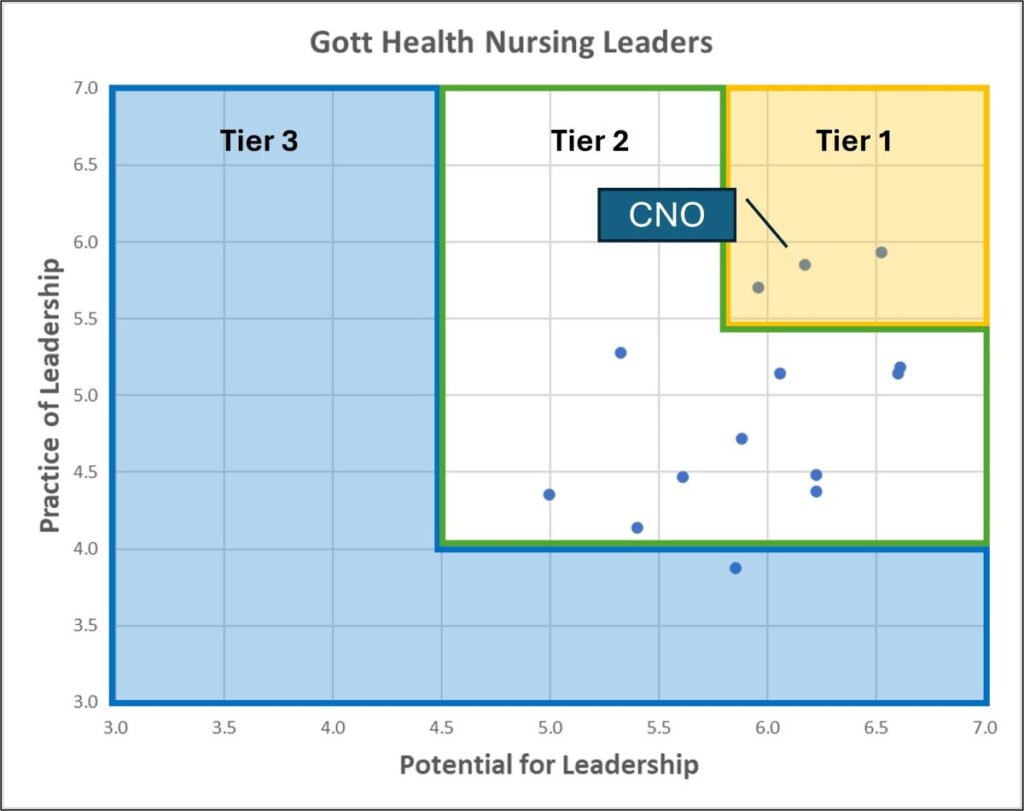
The leadership team was then plotted, then segmented into tiers based on their individual assessments. The tiers were determined based on positioning and refined with AI. Three leaders were considered Tier 1 leaders (including the CNO), eight leaders were categorized as Tier 2 and one leader was included in Tier 3.
Based on this, the CNO was able to reduce the number of direct reports from 13 to 7 by consolidating positions based on similar work and the best utilization of each person’s leadership abilities.
Strategies were developed to retain the top leaders and grow the next tier of leaders. Some leaders in Tier 2 were realigned to report to more experienced leaders. The sole leader in Tier 3 was moved to Tier 2 based on their peer assessments which indicated they had understated their leadership abilities. Overall, they have become a more effective team as the assessment process helped them appreciate and understand each other better.
Organization-Wide Impact
The overall nursing organization has increased productivity at all levels as the senior leaders impacted their direct reports who impacted their direct reports and so on. This has resulted in improving the culture of the entire nursing organization as reflected in their reduced attrition.
Conclusions
LeadershipRM™ delivered more than structural realignment – it empowered Gott Health to build a stronger, more resilient nursing leadership team. With data-informed clarity, the CNO not only solved a pressing organizational challenge but strengthened the entire leadership pipeline.
Consequently, the project was considered a success on multiple leadership fronts.
LRM works not just in healthcare or at senior leadership, but it’s a solution that can impact any industry and at any organization level.
Book a 30-minute Executive Briefing to explore whether LeadershipRM™ is the right fit for your organization’s growth and retention goals.
LeadershipRMTM Overview | Toxic Leader Analysis |
Leadership Misalignment | High-Valued Leader Retention
Financial Impact Calculator | LeadershipRMTM Case Study
Request Additional Information