

Data-Informed Leadership Resources Management™ Strategic Pilot
Leadership Resources Management™ (LeadershipRMTM) is a data-informed strategic approach that helps executive teams align leadership capacity, roles, accountability, and decision-making with the priorities that drive enterprise value.
The pilot combines leadership data, organizational context, financial-impact analysis, and executive judgment to identify where leadership resources can create greater strategic return.
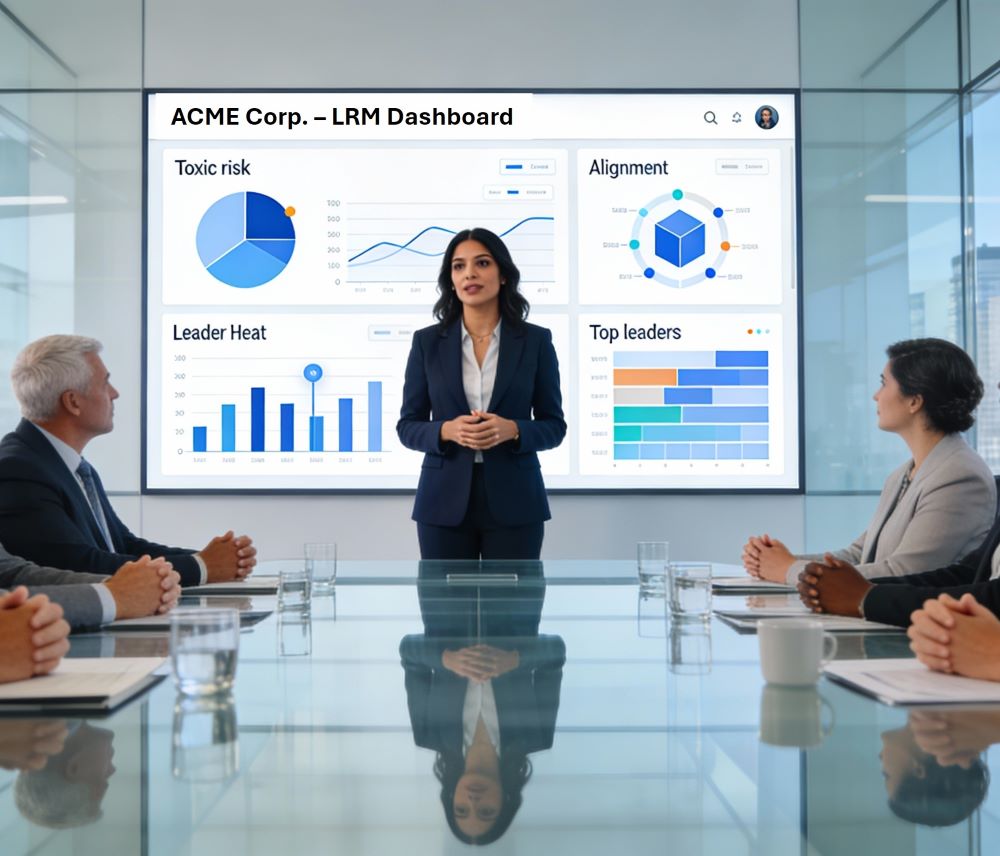
LeadershipRMTM Strategic Pilot Study
Your Strategy Cannot Outperform the Leadership System Responsible for Executing It
Too many leadership decisions are based primarily on anecdote, organizational politics, tenure, or broad engagement indicators. LeadershipRM™ introduces a more disciplined, data-informed basis for decision-making—helping executives distinguish perception from evidence, identify patterns that affect performance, and prioritize action around the leadership issues with the greatest strategic consequence.
From Leadership Opinion to Informed Executive Decisions
LeadershipRM™ uses relevant quantitative and qualitative evidence to inform, not replace, executive judgment.
Data-informed approaches are especially useful when organizations must connect workforce or leadership decisions to changing business needs, current capabilities, future gaps, and measurable outcomes.
Leadership Is Not Only a Development Issue. It Is a Resource Allocation Issue
Organizations routinely make disciplined decisions about capital, technology, facilities, and operations. Leadership resources deserve the same rigor.
Too many leadership decisions are based primarily on anecdote, organizational politics, tenure, or broad engagement indicators. LeadershipRM™ introduces a more disciplined, data-informed basis for decision-making—helping executives distinguish perception from evidence, identify patterns that affect performance, and prioritize action around the leadership issues with the greatest strategic consequence.
From leadership opinion to informed executive decisions
LeadershipRM™ uses relevant quantitative and qualitative evidence to inform—not replace—executive judgment.
Data-informed approaches are especially useful when organizations must connect workforce or leadership decisions to changing business needs, current capabilities, future gaps, and measurable outcomes.
LeadershipRMTM creates a structured basis for answering a more consequential question:
“Are we deploying our leadership resources where they can create the greatest strategic and financial value?”
Strategic Questions:
- Which enterprise priorities require the greatest leadership capacity over the next 12–36 months?
- Where are leadership roles misaligned with the work, authority, or outcomes required?
- Where is leadership capacity underutilized, duplicated, or creating organizational drag?
- Which leadership risks could undermine performance, retention, or transformation?
- What changes would most improve leadership return on investment?
Strategic workforce and human-capital approaches use this same logic: start with enterprise objectives, assess the current-state capability base, identify gaps, define accountability, and track outcome measures such as productivity, efficiency, quality, and business impact.
A Strategic System for Managing Leadership Resources
Leadership Resources Management™ goes beyond individual development, succession planning, or a stand-alone leadership assessment. It examines leadership as an interconnected organizational system: the capacity available, the work that must be led, the alignment between leaders and roles, the risks embedded in the system, and the return created by better deployment.
Four Strategic Lenses:
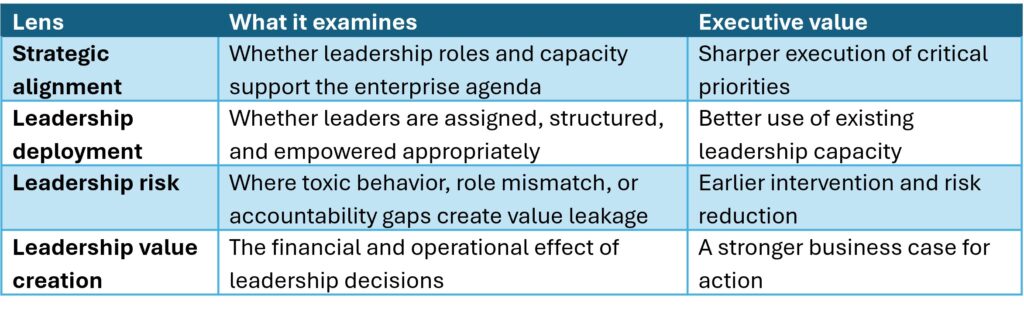
What Informs the LeadershipRM™ Analysis
The specific data sources vary by organization and pilot scope. They may include:
- Leadership-role, reporting-relationship, and span-of-control information
- Business priorities, operating-performance measures, and strategic initiatives
- Leadership assessment findings and stakeholder input
- Employee-retention, turnover, and high-performer-risk indicators
- Compensation, leadership-investment, and financial-impact assumptions
- Organizational-design, accountability, and decision-flow observations
The purpose is not to create a scorecard for its own sake. It is to translate relevant leadership and organizational data into clearer choices about leadership deployment, risk, and investment.
That framing is consistent with strategic workforce planning: analyze current workforce conditions, anticipate future requirements, identify gaps, and connect action plans to enterprise objectives.
What the Strategic Pilot Delivers
The pilot is a focused data-informed executive engagement designed to create clarity before the organization commits to broader leadership, talent, or organizational-change investments.
Phase 1 — Define the Strategic Context
Clarify the enterprise priorities, operating challenges, and measurable outcomes that matter most.
Phase 2 — Gather Relevant Evidence
Compile the leadership, organizational, performance, and stakeholder data appropriate to the pilot scope.
Phase 3 — Analyze Alignment and Risk
Identify patterns of leadership-resource alignment, underutilization, role mismatch, behavioral risk, and potential value leakage.
Phase 4 — Deliver an Executive Action Agenda
Translate findings into a prioritized, data-informed set of leadership actions, investment choices, and next steps.
The pilot does not require perfect data. It begins with the evidence available, identifies what can be learned confidently, and makes clear where additional information would strengthen future decisions.
Pilot outputs
- Leadership-resource alignment findings
- Strategic risk and opportunity map
- Prioritized action agenda
- Executive briefing and recommendations
- ROI and value-impact discussion where data are available
From Leadership Data to Better Strategic Decisions
The value of LeadershipRM™ is not simply in generating findings. It is in helping executive teams interpret available data, quantify where appropriate, and make more deliberate decisions about leadership structure, role alignment, behavioral risk, retention, and investment.
In a recent 24-person Leadership Resources Management project demonstrated substantial ROI potential across three leadership-value categories:
- 1688% ROI from toxic-leader analysis
- 400% ROI from misaligned-leader analysis
- 156% ROI from high-performer retention analysis
These figures illustrate potential value in a prior pilot; they are not a guaranteed outcome. Each organization’s analysis, financial assumptions, and results depend on its leadership context and action taken.
A related case study presented at the 2025 SHRM national conference showed how leadership reassignment, role realignment, and response to toxic leadership contributed to an estimated $2.3 million in annual financial impact.
Turn Leadership Evidence Into Strategic Action
If your organization needs a more disciplined, data-informed view of leadership capacity, alignment, and risk, the LeadershipRM™ Strategic Pilot provides a practical starting point.
Share the strategic priority or leadership challenge you are addressing. We will follow up to discuss the relevant data available, the scope of the analysis, and whether the reduced-rate LeadershipRM™ pilot is a fit.
Each Pilot Involves
- Minimum 20 persons
- Personalized results report and 1 hour of one-on-one coaching for each leader in the pilot
- Summary report for the executive leader or sponsor
If your organization is interested in identifying hidden leadership costs and understanding where stronger alignment could improve performance, complete our Pilot Study Information Form to start the conversation.