

Development is Valuable. Management is Essential.
Leadership development builds skills, self-awareness, and capability. It is an important investment—but it does not, by itself, answer the strategic questions executives must manage.
A leadership program cannot ensure that:
- Critical roles are clearly defined and appropriately staffed
- Leadership talent is deployed against the organization’s highest-priority opportunities
- Promotion and assignment decisions reflect the demands of the role, not simply past performance
- High-value leaders are retained through meaningful opportunity, support, and career visibility
- Emerging leadership risks are addressed before they become costly organizational problems
- The organization can measure whether leadership investments improve readiness, stability, and execution
LeadershipRM™ connects leadership development to the decisions and systems that determine organizational performance.
[READ MORE: Why Leadership Development Is Not Leadership Management]
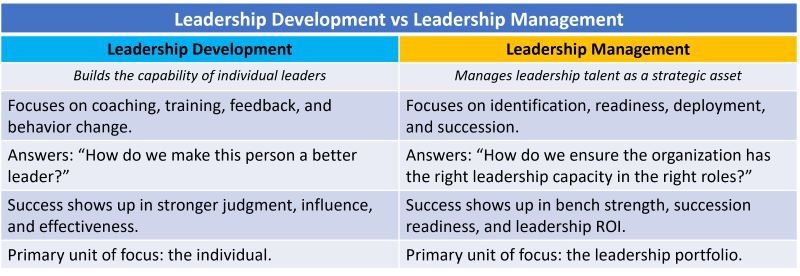
Many organizations say they are investing in leadership. But when you look closer, they usually mean leadership development: training, coaching, workshops, and other ways to build the skills of individual managers or high-potential employees.
That matters. But it is not enough.
If leadership development builds the leader, leadership management builds the system.
Leadership management is the organizational discipline of identifying, developing, and deploying leadership talent with the same rigor used to manage any high-value asset. It is not a course catalog. It is not a one-time retreat. It is not a performance review with a new name.
It is a business strategy.
LeadershipRMTM Overview | Why Leadership Management
LeadershipRMTM Framework | LeadershipRMTM Metrics
Leadership Risk & Continuity | LeadershipRMTM Case Study
Financial Impact Calculator | Request Additional Information
Move from leadership activity to data-informed leadership management.
[Schedule an Executive Strategy Session]