

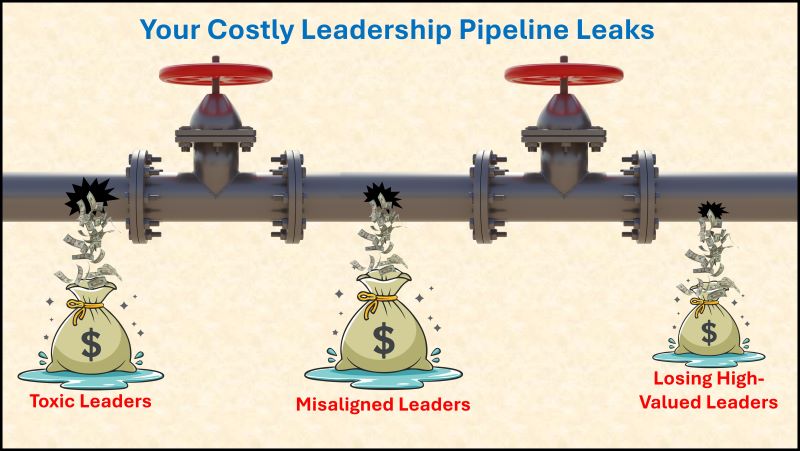
It’s nighttime. Everyone in the house is asleep, but you hear a faint sound somewhere nearby. It’s easy to ignore at first, especially if the TV has been on or the day has been noisy. You get up to check and discover a dripping faucet. You make a mental note to call the plumber in the morning.
Or maybe you don’t hear anything at all, until the next morning when you step into an inch of water on the floor. The leak was hidden behind a wall, and by the time you found it, the damage was already done.
That is what happens when organizations fail to identify toxic and misaligned leaders early.
The Toxic Leak
Toxic leaders are often hard to spot because they can look successful on the surface. They may be top sales performers, respected physicians, strong marketers, or financial stars. They know how to manage up. But behind the scenes, peers and direct reports may be experiencing something very different.
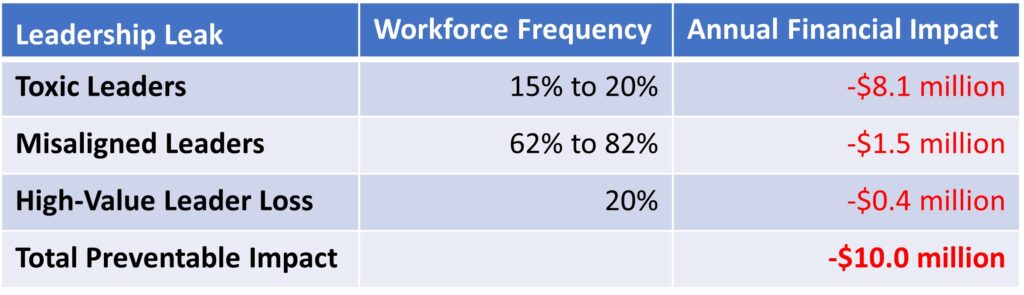
Toxic leadership drives disengagement, lost productivity, and higher turnover. Research suggests toxic leaders make up 15% to 20% of the workforce and can cost 3 to 5 times their annual salary.
The Misaligned Leak
Not every leadership problem is toxic. Some leaders are simply misaligned. These are often strong individual contributors who were promoted into management even though they are not well suited for it, do not want to lead people, or should not be leading people at all.
This is more common than many organizations realize. Gallup has found that 90% of workers do not believe the person they report to is ready to lead.
Misalignment also creates real costs through lower morale, weaker productivity, and avoidable turnover. One estimate places the cost at about $12,000 per misaligned leader per year.
The High-Value Leak
The third leak is the loss of high-valued leaders. These are the people who bring fresh thinking, creativity, and strong focus. They are also highly marketable, which means they can be difficult to retain.
High-valued leaders comprise 15% to 21% of the workforce with a replacement cost of 0.5 to 2.0 times their annual salary according to SHRM.
When high-valued leaders leave, the damage goes beyond replacement costs. Strategic work slows down, customer confidence can weaken, and innovation suffers. In many cases, they leave because they are tired of working for toxic or misaligned leaders.
Why This Matters
Any one of these leaks should concern a senior executive. Together, they can quietly drain the organization’s performance, culture, and future leadership capacity.
For a 1,000-person organization, here is a low estimate of the impact of these 3 leaks from our LeadershipRM™ Financial Impact Calculator.
The risk is not only financial. There is also reputational risk, innovation risk, competitive risk, and legal risk when leadership problems go unaddressed.
Next Steps
The issue is not whether your organization has leaks in its leadership pipeline. The real question is how big the leaks are. A little caulk will not fix structural damage.
These problems require a data-driven approach to identify toxic, misaligned, and high-value leaders, then take the right coaching, consulting, and retention actions. For organizations that are ready to take a closer look, a multi-rater, multi-level leadership analysis can reveal patterns that are often missed from the top.
Contact me to schedule a 30-minute executive briefing and learn how a pilot study can help close the leadership leaks costing your organization time, talent, and money.