

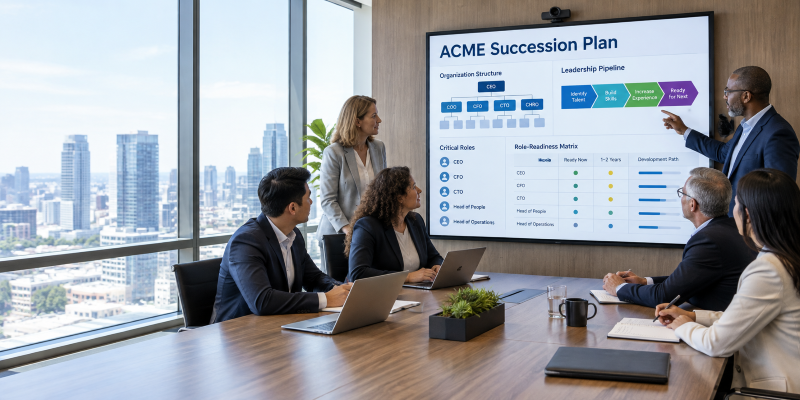
A succession plan identifies who could step into a critical role. It cannot, on its own, ensure that person will be ready and available when the vacancy occurs. Even a plan that is reviewed regularly throughout the year can be weakened when a leading successor leaves, either for a better opportunity elsewhere or after working under a toxic or misaligned leader who did not value their abilities.
The further an organization has to go down its succession plan, the more risk it is taking on. It is a little like replacing a .375 hitter with a .250 hitter. The team keeps functioning, but it loses something real.
Why a Plan Alone Is Not Enough
A succession plan is a snapshot. It lists incumbents with a readiness label attached. What it does not tell you is whether that person is still engaged, still growing, or quietly getting recruited away. It also does not tell you whether the roles you are planning for are still the roles your strategy will actually need.
What Leadership Resources Management Changes
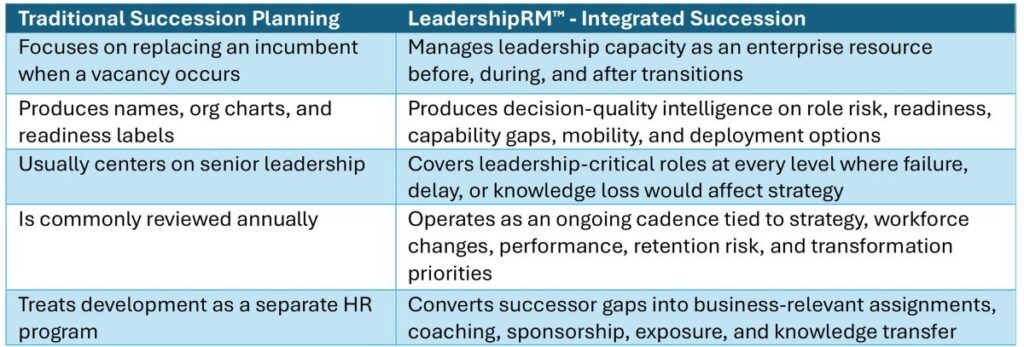
Leadership Resources Management, or LeadershipRM™, is a system for managing leadership capacity across the whole organization rather than for filling a single role. It turns succession from a replacement-chart exercise into an approach for continuously identifying, developing, and deploying leadership capacity where the organization needs it most.
Here is what changes in practice.
Think of LeadershipRM™ as CRM for Leadership
Most organizations now run a CRM for customers. The best CRMs are proactive. They track cues and behaviors that may indicate a change in a customer’s purchasing habits before the customer calls to cancel. LeadershipRM™, shortened to LRM, does the same thing for the people who run your business.
Instead of waiting for a resignation letter to find out your succession plan has a leak, LRM helps executives review the cues and behaviors that may indicate a high-value or high-potential leader is frustrated, stalled, or being recruited away. It strengthens the succession plans your organization has already spent a lot of time and money building.
How LRM Works in Practice
LRM is built around a few core moves.
Start With Enterprise Strategy
Begin with the strategy, the operating model, the growth agenda, and the material risks facing the organization. Do not begin with a list of incumbents approaching retirement. Succession planning should start with the leadership the business will actually needs, not the leadership it currently has.
Classify Leadership-Role Risk
For every critical role, LRM builds a practical risk profile that combines strategic importance of the role, likelihood the incumbent departs, concentration of institutional knowledge, availability of internal successors, and the cost of sourcing a viable replacement.
This prevents a common mistake: treating every senior role as equally important while overlooking operational, technical, commercial, or relationship-intensive roles that create more exposure than their place on the org chart suggests.
Retain High-Value and High-Potential Talent
High-value and high-potential people are not motivated by compensation alone. Challenge, responsibility, and the sense that their work matters also shape their decisions. LRM acts on that in practical ways.
- Remove obstacles to their success, including toxic or misaligned reporting relationships.
- Match their role to their strengths while giving them real opportunity to compensate for their weaknesses.
- Assign them consequential work, connecting their responsibilities directly to the organization’s priorities.
- Recognize and credit their contributions publicly and give them visibility with senior leaders.
- Hold stay conversations early and often, and actually act on what they say.
The Executive Takeaway
The objective is not just to name successors. It is to give senior management a reliable view of leadership risk, bench strength, readiness, development priorities, and deployment options across business-critical roles.
Succession planning asks: Who could replace this leader?
LeadershipRM™ asks: What leadership capacity do we need to execute strategy, where is it constrained or at risk, and how should we develop and deploy it for maximum organizational resilience?
That is the shift from a reactive HR process to an executive discipline for protecting continuity, strengthening strategic execution, and building a sustainable internal leadership pipeline.
Contact me to schedule a 30-minute executive briefing and learn how a pilot study can help fortify your organization’s succession plans.